

Spring Butter Bolete
Butyriboletus primiregius
Key Features: - Dark burgundy to wine-red cap - Bright yellow pores that bruise blue - yellow stem with fine net-like reticulation - Thick, firm yellow flesh - Spring fruiting with fir trees.
Identification Notes
Cap:
Broad and fleshy, initially rounded to convex and sometimes becoming somewhat wavy or lobed with age. Surface ranges from tacky to dry an is often coated with bits of soil or forest debris. Color is typically dark burgundy to wine-red when young, resembling a red potato, often developing browner tones as it matures.
Pore surface:
Pores are small and round, beginning pale yellow and becoming bright yellow to olive-yellow with age. young specimens may show little or only weak blue staining, while mature specimens can bruise blue more readily.
Stem:
Typically, stout and club-shaped or swollen when young, sometimes becoming more evenly proportioned with age, or pointed. Lemon-yellow to butter-yellow, occasionally with reddish coloration toward the lower portion. A fine net-like reticulation is usually visible over the upper part of the stem. Handling may produce some blue staining.
Flesh:
Thick, dense, and especially firm in young mushrooms. Flesh is distinctly yellow, particularly in the stem, and may remain unchanged or develop irregular bluish staining when cut.
Taste: mild, not bitter
Ecology and habitat:
Found singly, scattered, or in groups and arcs in conifer forests, particularly with fir. It may remain partially buried beneath the forest duff as it develops, sometimes forming noticeable humps in the forest floor. Fruiting in spring and early summer.
Comments: The spring butter bolete is most commonly confused with our local bitter bolete (Caloboletus species), but that species has a cap that is drabber with buff to gray tones and a slightly fuzzy surface., a stem that is blushed rosy red, and swift, dramatic bluing on pores and exposed flesh. The taste is very bitter.

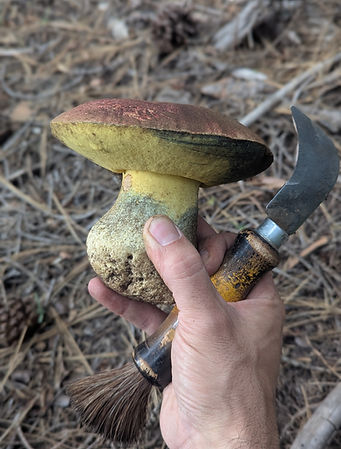

Small, yellow pores under the cap and net-like reticulation on the upper portion of the stem.
Burgundy tone in a young cap with forest debris adhering.
Blue bruising on pore surface and stem. Stem swollen at the base.

Contact
I'm always looking for new and exciting opportunities. Let's connect.
123-456-7890